A fitted hat size chart looks like a small detail until a team order arrives and a third of the caps perch on top of heads like party hats. Sizing mistakes on headwear cost more than on shirts, because a cap cannot be tailored and an embroidered one cannot go back on the shelf.
Hat sizing also runs on a different logic from apparel. Some caps use numeric sizes, some use dual sizing like S/M and L/XL, and many use adjustable straps that hide the problem until someone with a large head tries one on.
This guide covers how to measure, how to read the chart and how the style of cap changes the answer. At Sew NC, we embroider caps for teams, businesses and organizations every week; the sizing questions below come up on nearly every headwear order.
Why a Fitted Hat Size Chart Matters Before You Order
A shirt that runs a half size small still gets worn. A cap that squeezes the forehead gets left in the truck. Fit decides whether headwear is worn, and worn headwear is the only kind that advertises anything.
A fitted hat size chart gives a team a shared language. Instead of “maybe medium,” you get a measurement that maps to a number or a stretch range, and that number is what a production partner can order against.
Once a logo is stitched into a structured cap, the piece is committed, and a decorated hat that does not fit is rarely something another person can use. Measuring first is far cheaper than reordering.
How to Measure a Head Correctly
Use a soft tape measure, the kind used for sewing, wrap it around the head about half an inch above the eyebrows and ears across the widest part at the back of the skull. Keep it level all the way around, snug but not tight, and read the number where the tape meets the end.
Measure twice and write down both readings. A tape that drifts higher at the back gives a smaller number than the real fit, and that single error moves a person a full size.
No tape on hand? A piece of string also works. Wrap it the same way, mark the overlap with a pen, then lay it flat against a ruler. Thick hair, braids, and tied-up styles add volume, so measure the way the person normally wears their hair under a cap.
Accurate numbers are what make any fitted hat size chart useful, and a rushed reading undoes the whole exercise. When the reading lands between two sizes, go up. A slightly loose cap can be managed with a sweatband or a strap. A cap that is slightly tight gives a headache by lunchtime.
Reading the Fitted Hat Size Chart
Use this fitted hat size chart as a starting point. Brands vary by roughly a quarter inch, so check the manufacturer’s chart for the exact style before you place an order.
| Head circumference (in) | Head circumference (cm) | Fitted size | Typical stretch label |
| 21 1/4 | 54.0 | 6 3/4 | S/M |
| 21 5/8 | 54.9 | 6 7/8 | S/M |
| 22 | 55.9 | 7 | S/M |
| 22 3/8 | 56.8 | 7 1/8 | S/M |
| 22 3/4 | 57.8 | 7 1/4 | S/M or L/XL |
| 23 1/8 | 58.7 | 7 3/8 | L/XL |
| 23 1/2 | 59.7 | 7 1/2 | L/XL |
| 23 7/8 | 60.6 | 7 5/8 | L/XL |
| 24 1/4 | 61.6 | 7 3/4 | L/XL or larger |
The stretch column is approximate. S/M usually covers the smaller half of the adult range and L/XL the larger half, though each brand draws the line in a slightly different place. A reading of 22 1/2 inches sits between 7 1/8 and 7 1/4, and the larger size is the safer pick for most people.
Fitted, Stretch Fit, and Adjustable: What the Labels Mean
A fitted cap is sized in numbers and has no adjustment. It looks the cleanest on the head, and it gives no forgiveness when a measurement is off.
A stretch fit cap uses elastic fabric or a stretch band across a range, often S/M or L/XL. It covers more heads per size than a numeric fitted cap and still reads as a close, clean fit.
An adjustable cap closes with a snap, strap, or buckle. It is the most forgiving option for mixed groups because one style covers a wide span.
Our headwear catalog includes stretch and Flexfit-style caps in SM to LXL ranges, along with adjustable snapback, trucker, and dad hat styles. Numeric fitted sizes depend on the specific cap, so ask about availability in the style you want before you build a plan around it. The honest trade-off is simple: the cleaner the fit, the less room for sizing errors, and that is precisely where a fitted hat size chart earns its place.
Crown Height and Profile: Why Low Profile Hats Fit Differently
Two caps with the same circumference can feel different on the same head. The difference is crown height and structure.
Low profile hats sit closer to the head with a shallower crown. They suit people who dislike a tall cap and give a more casual, modern look. The front panel is shorter, which limits logo height, so artwork needs to stay compact.
Structured caps use stiff buckrams behind the front panels. They hold their shape, keep the logo upright, and can feel tighter across the forehead until they break in. Unstructured caps are soft and collapse easily, and they tend to feel more relaxed on the first wear.
When you read a fitted hat size chart, treat the circumference as the baseline and the style as a modifier. A person at the top of one size should move up if the cap is structured or has a deep crown.
Custom Trucker Hats and Snapbacks: Sizing Without Numbers
Custom trucker hats are the easiest style to order for a mixed group. A mesh back and an adjustable snap cover a wide range, and one size fits most adults without a measurement for each person.
Most is the key word. People at the extremes still struggle. A very large head pushes the foam front panel outward, and a small head leaves a gap that tips the cap back. The snap adjusts the back of the cap, but the front panel does not stretch.
Our catalog lists many trucker and snapback styles, including low profile versions for people who prefer a shallower crown. For a team with a wide range of head sizes, a trucker with a plastic snap is usually the most practical choice, and a stretch cap works better for people who want something closer to the head.
Even then, run the group’s measurements through a fitted hat size chart so you know how many people sit at the extremes. If you are unsure of the group, ask the production team which trucker styles run larger or smaller. Small differences between brands add up across a full order.
Sizing Youth, Women, and Mixed Teams
A mixed team is where a fitted hat size chart earns its keep. Adult sizes do not suit children, and many youth caps are cut on a smaller pattern with a lower crown.
Women often have long hair tied back, so check whether a cap has a ponytail opening or a lower back panel. Hair volume changes how a cap sits, and measuring with the hair worn as usual avoids surprises.
If the group includes kids, measure them separately and confirm that your chosen style comes in a youth size, because not every cap does. Where youth sizes are unavailable, an adjustable cap with a tighter strap range is often the workaround.
A short sizing form saves time. Ask each person for a head measurement, their preferred style, and any comfort concerns such as sensitivity to tight bands. It takes a few minutes and prevents most of the problems that show up after delivery.
How Embroidery Affects Fit on Custom Embroidered Hats
Custom embroidered hats do not fit exactly like blank ones. Dense stitching stiffens the front panel, and a large, heavy logo can pull the fabric and make an unstructured cap feel less flexible.
Size and placement matter. A design that fills the whole front panel of a low profile cap leaves little breathing room, and it can pucker around the edges. Keep artwork proportional to the panel height, and avoid tiny text that thread cannot hold.
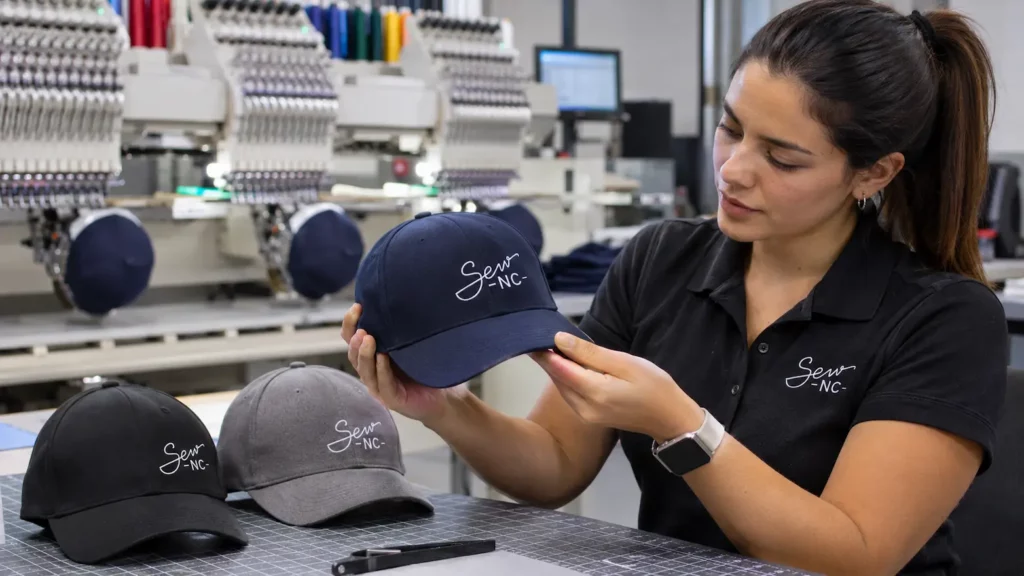
At Sew NC, we digitize every logo in house and embroider caps in our own shop, then send a digital proof for your approval before production starts. If you are comparing styles, our custom embroidered hats and caps show structured, unstructured, trucker, and beanie options in one place.
The proof is the moment to check how the logo sits relative to the seam and the brim, not just whether the colors match. Treat the fitted hat size chart and the logo size as one decision, since each affects the other.
Ordering Sizes for a Team
Ask for measurements when the group is small enough. For a staff team or a sports squad, a quick survey gets accurate numbers and removes guesswork.
For larger groups, most adults land near the middle of the chart, so the middle sizes carry the order. Add a buffer for late additions and replacements, commonly 10 to 15 percent, and keep the extra pieces in the sizes people most often swap.
When sizes are unknown, pick a style that absorbs error. An adjustable trucker or a stretch cap removes most of the risk, and a fitted hat size chart then serves as a check on the few people at the edges.
Leave room on the calendar. Decorated orders commonly run two to three weeks from proof approval, and a late size correction can push the delivery date. Settling the sizes first protects every date that follows.

Put the Fitted Hat Size Chart to Work Before You Order
The sequence is short: measure, read the chart, choose a fit type, adjust for profile and structure, confirm the embroidery size, and order with a buffer. Skip a step and it usually reappears as a cap that does not stay on a head.
At Sew NC, we help teams, schools, businesses, and local organizations match cap styles and sizes to the group before anything is stitched. Contact our team for sizing guidance before ordering custom hats with headcount, your preferred style, and the date you need.