Most corporate merchandise ends up in a drawer somewhere, in a charity shop or at the back of a closet. Not because branded merchandise does not work, but because most of it is selected without much thought about whether the person receiving it will actually find it useful. Items that generate true return become permanent parts of people’s daily routines. This is not an accident and starts with the selection process before any logo is put on anything.
Sew NC partners with businesses and organizations to develop corporate merchandise programs that fulfill real needs of recipients, not around what fits a per-unit budget target or a catalog default.
Why Most Corporate Merchandise Underperforms
The gap between corporate merchandise that generates sustained brand impressions and merchandise that disappears within a week is almost always a selection problem. The item was chosen for the wrong reasons, by the wrong criteria, for the wrong audience.
Price per unit is the most common driver of poor merchandise selection. An item that costs less per piece and gets set aside after a single use is not a bargain. It is a sunk cost with zero return beyond the moment of distribution. The math on cost per impression over the life of a well-chosen, regularly used item looks completely different from the math on a cheap giveaway that gets discarded.
Items picked from a catalog that have not been hand selected with the particular recipient in mind will generally yield the same results. A logoed stress ball at a tech conference, a branded pen at a construction trade show or plastic totes at a client appreciation dinner all have the same problem: they were not selected because they fit the audience. They were selected because they were available and inexpensive.
Many of the organizations that get the greatest value from their company merchandise are treating the selection process as a strategic decision rather than an afterthought of the procurement process. Basic questions that need to be answered before ordering such as who will receive the item, where will they use it and how often that person spends their time, what they already own that is similar, and whether a branded version of this item would displace something they currently use. Those questions are not complicated. They just require asking them before placing the order.
Apparel as the Highest-Return Merchandise Category
Branded apparel is not typically categorized alongside pens and tote bags in how people think about company merchandise, but the impression data makes a strong case for treating it as the anchor of any corporate merchandise program that takes return on investment seriously.
A quality branded hoodie worn twice a week generates more impressions in a month than most other promotional items generate in their entire lifespan. It travels into grocery stores, restaurants, neighborhood events, and weekend activities. Every appearance is an organic impression in a real-world context that paid media cannot reach. For local businesses whose customers and prospects live in the same community the brand serves, that geographic concentration of impressions makes apparel-based corporate merchandise particularly effective.
The items that perform best are the ones people would reach for even without the brand on them. A well-made quarter-zip in a color someone actually wants to wear, with a clean embroidered logo that does not dominate the garment, earns its place in a rotation independently. The brand visibility is a byproduct of a daily choice the wearer makes without being prompted.
Apparel selection for a corporate merchandise program follows the same logic as any staff apparel decision: the garment needs to fit the audience’s context, the decoration needs to be applied with a method that matches the product’s lifespan, and the quality needs to be high enough that the item reflects well on the brand every time it is in use.
Headwear: Visible, Functional, and Consistently Worn
Hats sit at eye level in public spaces. That single characteristic explains why headwear consistently ranks among the highest-impression categories in corporate merchandise across industry research. A branded hat worn at a weekend event, a morning run, or a community gathering puts the logo exactly where visibility happens, without any additional effort from the brand that produced it.
Structured caps with embroidered logos are the most durable and polished headwear option in the corporate merchandise category. The front panel provides a stable embroidery surface, the logo registers consistently across every unit in a run, and the finished product communicates intentionality. For client gifts, employee recognition programs, and event merchandise, a well-made embroidered cap in the brand’s primary color is a product people keep across seasons.
Beanies as promotional items with logos are particularly effective in markets with genuine cold winters. A beanie worn daily from November through March generates sustained impressions over a period that most paid campaigns would struggle to sustain. The functional value of the product must ensure consistent use by the wearer to generate sufficient volume of impressions to justify the initial investment by the business.
Casual formats like trucker hats and unstructured “dad hats” work well for very casual brands with an informal identity. The merchandise has to feel native to the context rather than imposed on it, which is part of what determines whether someone keeps wearing it past the first few days.
Drinkware and the Daily Routine Advantage
The promotional merchandise categories that produce the most sustained impressions share one characteristic: they fit into a routine the recipient already has. Drinkware is the clearest example. A quality insulated tumbler or travel mug with a clean logo shows up on a desk, in a car cupholder, at the gym, and at a coffee shop. That daily circulation reaches a different group of people every day without any additional action from the brand.
The difference between drinkware that stays in rotation for years and drinkware that gets replaced within months is almost entirely a quality decision. A poorly insulated cup that fails to perform gets swapped out quickly. A well-made one becomes part of a routine. The per-unit cost difference between those two products is real but rarely as large as the difference in return suggests it should be, and calculating the cost per impression over each product’s actual lifespan makes the case for quality clearly.
For client gift programs, a quality branded drinkware item is a gift that the recipient actually uses in professional and personal settings alike. For recruiting events, it is a first impression that communicates attention to quality. For employee recognition, it is a piece of company merchandise that communicates investment in the person receiving it rather than a token acknowledgment of their contribution.
Bags and Totes That Go Where the Brand Needs to Be
A branded bag that gets used for grocery runs, gym trips, and weekend errands is generating impressions in community settings the brand could not otherwise reach without significant paid media investment. The practical value of the bag is what drives the use. The brand visibility follows naturally from that use.
Canvas totes, branded backpacks, and utility bags each fit different recipient contexts. A canvas tote resonates with audiences whose values align with sustainable and reusable alternatives. A branded backpack is the right choice for youth programs, schools, and organizations whose members carry gear regularly. A utility bag or laptop bag fits professional contexts where the recipient spends time in meetings, at conferences, and at client sites.
For corporate merchandise distributed at conferences, recruiting events, or client onboarding sessions, a well-made branded bag is the item that continues working after the event is over. It travels into environments the brand might otherwise have no presence in and does so every time the recipient picks it up.
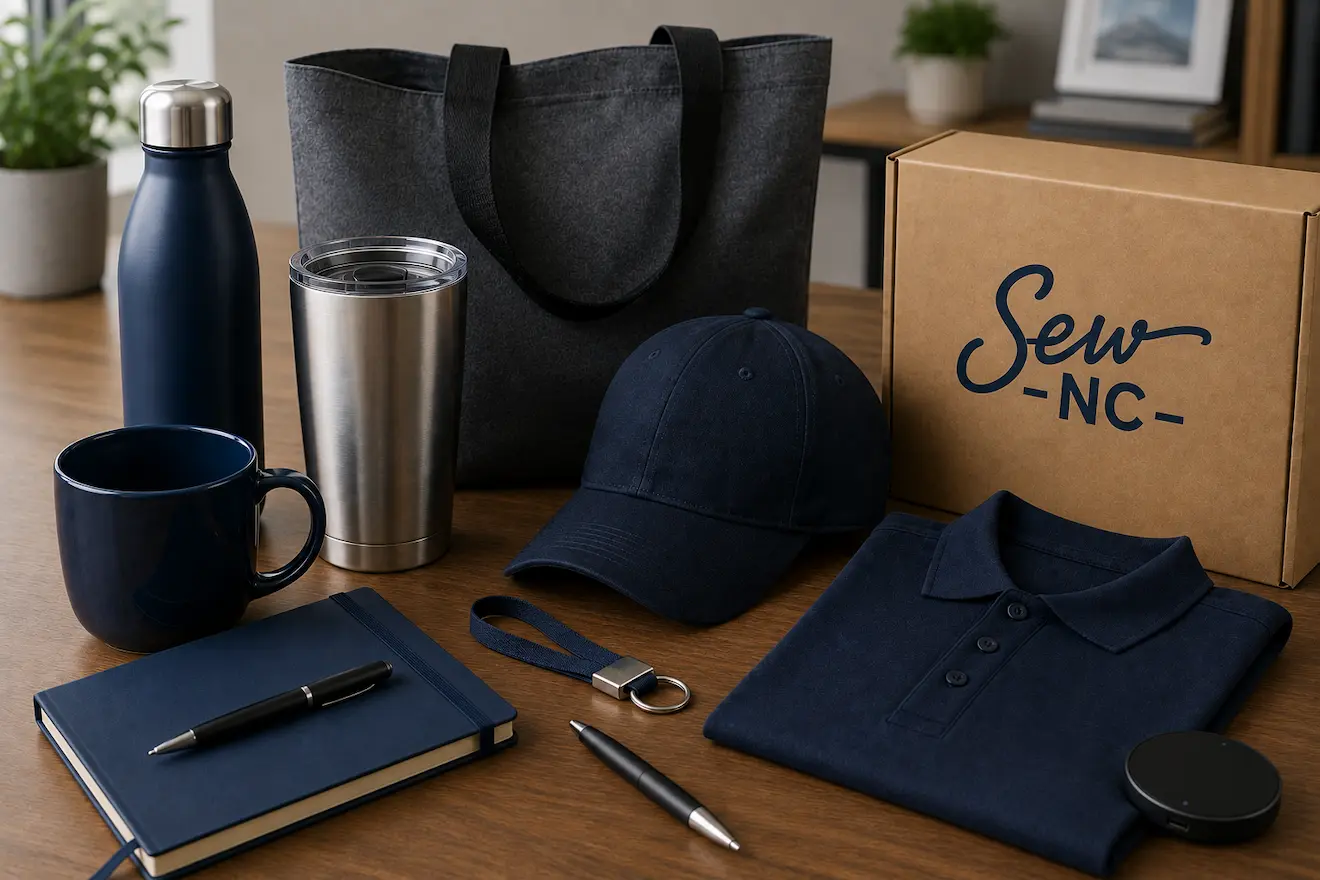
At Sew NC, we help businesses and organizations work through promotional items with logo selection based on audience context and program purpose rather than catalog defaults. Our promotional products services cover apparel, headwear, drinkware, bags, and branded merchandise for companies and organizations across the region. The goal is always the same: merchandise that earns a place in someone’s daily life rather than ending up in a drawer by the end of the week.
Corporate Merchandise for Employee Programs
The standards for internal corporate merchandise are higher than they are for external distribution, and the selection criteria are fundamentally different. Staff merchandise is not about generating impressions among an external audience. It is about communicating how the organization values the people who work for it, and recipients read that communication clearly in the quality and thoughtfulness of what they receive.
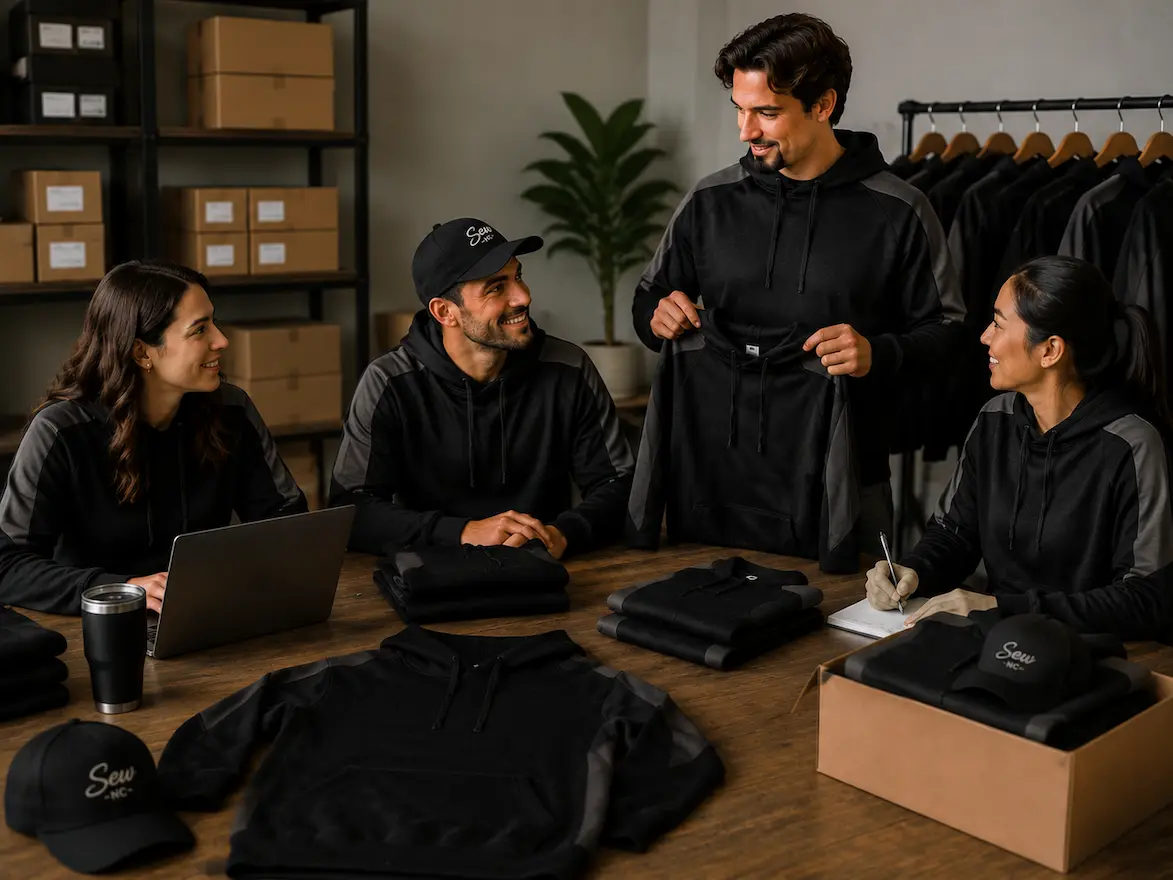
A simple onboarding merchandise kit of high quality branded merchandise (hoodie, hat and bag) will set the tone for the first day of a new employee in a way that no amount of subsequent communication can. Receiving something you actually want to use to start your new job, as opposed to a plastic bag with a stress ball and a lanyard, will give you that first impression that carries weight that is disproportionate to the cost of producing it.
While branded merchandise can make effective recognition programs, it is most effective when the chosen products are relevant to the people receiving them. That field people and office people have different daily realities is obvious, but it means that what works well for one group will not necessarily work for the other. Rather than treating both groups identically produces a program that satisfies neither particularly well. Asking rather than assuming is the practical step that turns a generic recognition program into one that generates genuine goodwill.
Seasonal merchandise, anniversary gifts, and milestone recognition items are best chosen with the same logic: an item chosen for a recipient is far more valuable than one chosen because it was on sale at the right unit price. The recipient will know the difference within a week, and it determines whether the program generates the internal goodwill it was designed to create or produces a polite acknowledgment that is forgotten within a week.
Merchandise for Events, Recruiting, and Client Outreach
Corporate merchandise distributed in event contexts carries an emotional association that standard giveaway items do not. An item received at a meaningful occasion, a company milestone, a community event, or an industry gathering, becomes part of how the recipient remembers that experience. The brand attached to the item inherits that association every time the item is used afterward.
For recruiting events and career fairs, the merchandise distributed to prospective employees is a physical extension of the employer brand. A quality branded item communicates that the organization pays attention to how it presents itself. The opposite message is equally clear and considerably harder to walk back in a first-impression context where candidates are simultaneously evaluating multiple organizations.
Client gift programs built around custom promotional products work best when the item is genuinely useful in the client’s professional or personal context. A quality insulated mug for a client who spends mornings on calls, a well-made branded bag for a client who travels regularly, or a seasonal item like a beanie for a client in a cold climate all fit naturally into how the recipient already lives and works. That fit is what determines whether a client gift builds goodwill or merely signals that the brand was thinking about them.
Community outreach programs benefit from merchandise that fits the specific context rather than generic branded items dropped into an event setting. A branded water bottle at a neighborhood cleanup, a logoed hat at a community sporting event, or a t-shirt at a local fundraiser all function as a contribution to the occasion rather than a promotional placement. That distinction between contribution and advertisement is something recipients perceive, and it shapes whether the brand association generated is positive or merely neutral.
Choosing Corporate Merchandise That Justifies the Investment
The return on a corporate merchandise investment is largely determined during the selection process, not during distribution. Items that will generate sustained impressions over an extended period can be identified before the order is placed by asking a small number of practical questions about the recipient and the context.
Will the recipient use this item in a setting where other people can see it? How often, and for how long? Does the quality of the item reflect the standards the brand is trying to communicate? Is the decoration clean, correctly sized, and applied with a method that will hold up across the item’s expected lifespan? Is the item specific enough to the recipient’s context to feel selected rather than generic?
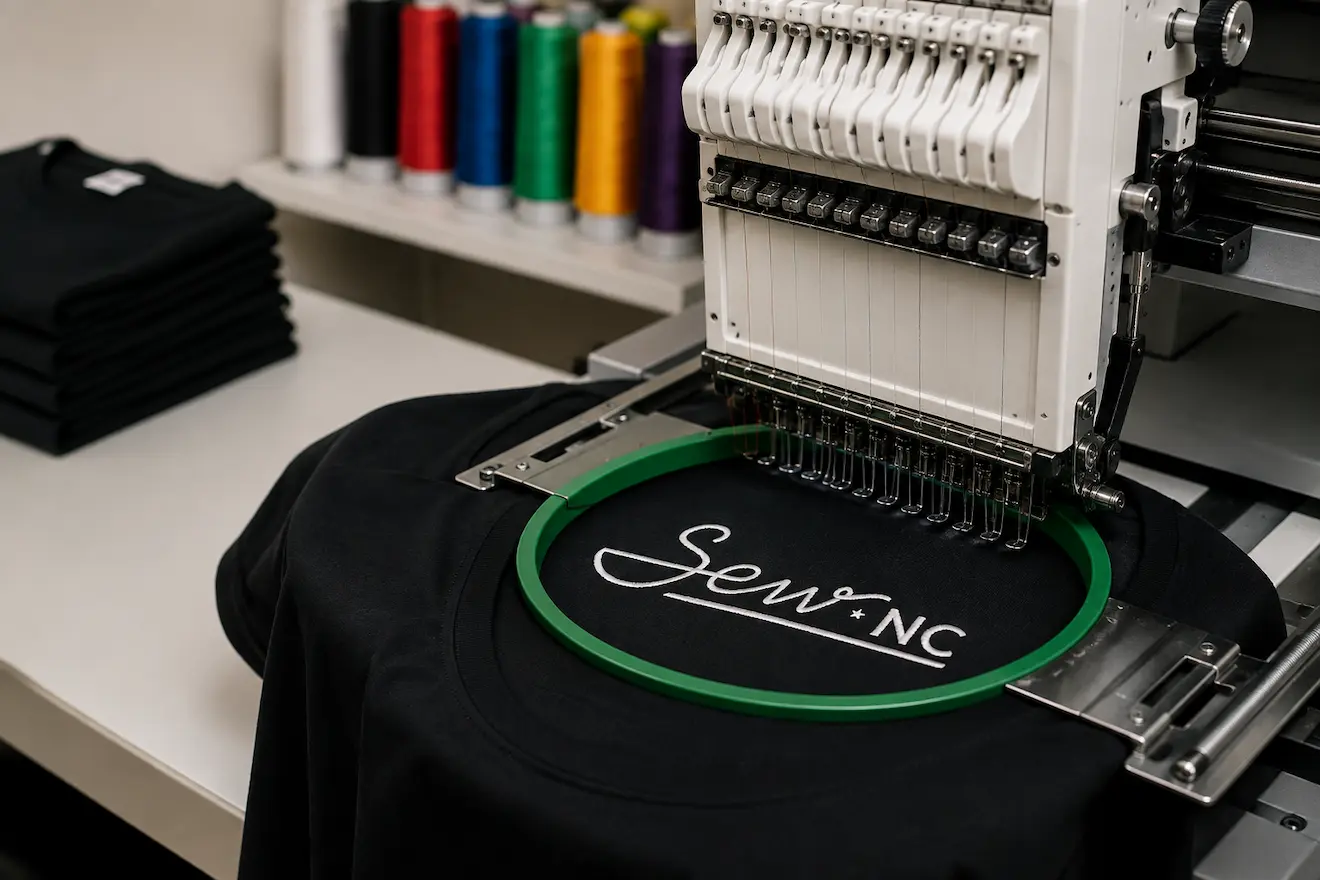
Decoration quality is the variable that determines whether a branded item builds recognition or undermines it. Promotional items with logo placement that is clean, correctly sized, and durably applied communicate that the brand was taken seriously. Merchandise with smeared prints, crooked embroidery, or heat transfers already lifting at the edges communicates something the brand did not intend to say, and it communicates it every time the item is in use.
Reach out through the Sew NC contact page to build a useful merchandise mix for your next company initiative. The selection process is where the return is determined, and it is a conversation worth having before the order is placed.