Embroidery vs. screen printing are the two options that often come up in business apparel conversations. Most people choose one without looking at the details of the order. Both methods are easy to get and they can look very good on the garment with the right artwork. If you pick one just because it is usual you might end up with a bad result. The choice matters because it changes the item in ways that the buyer will notice every time the apparel is worn.
At Sew NC, embroidery vs. screen printing is a conversation we work through with business buyers regularly, and the answer is almost always shaped by the same set of variables: the artwork, the garment, the quantity, and the intended lifespan of the decoration.
How Each Method Works in Production
Embroidery stitches thread directly into the fabric using a needle guided by a digitized stitch file. The design is converted from a vector or raster source into a stitch map that tells the machine where each needle pass goes in what direction and in what thread color. The result is a decoration that is physically part of the fabric structure rather than sitting on top of it.
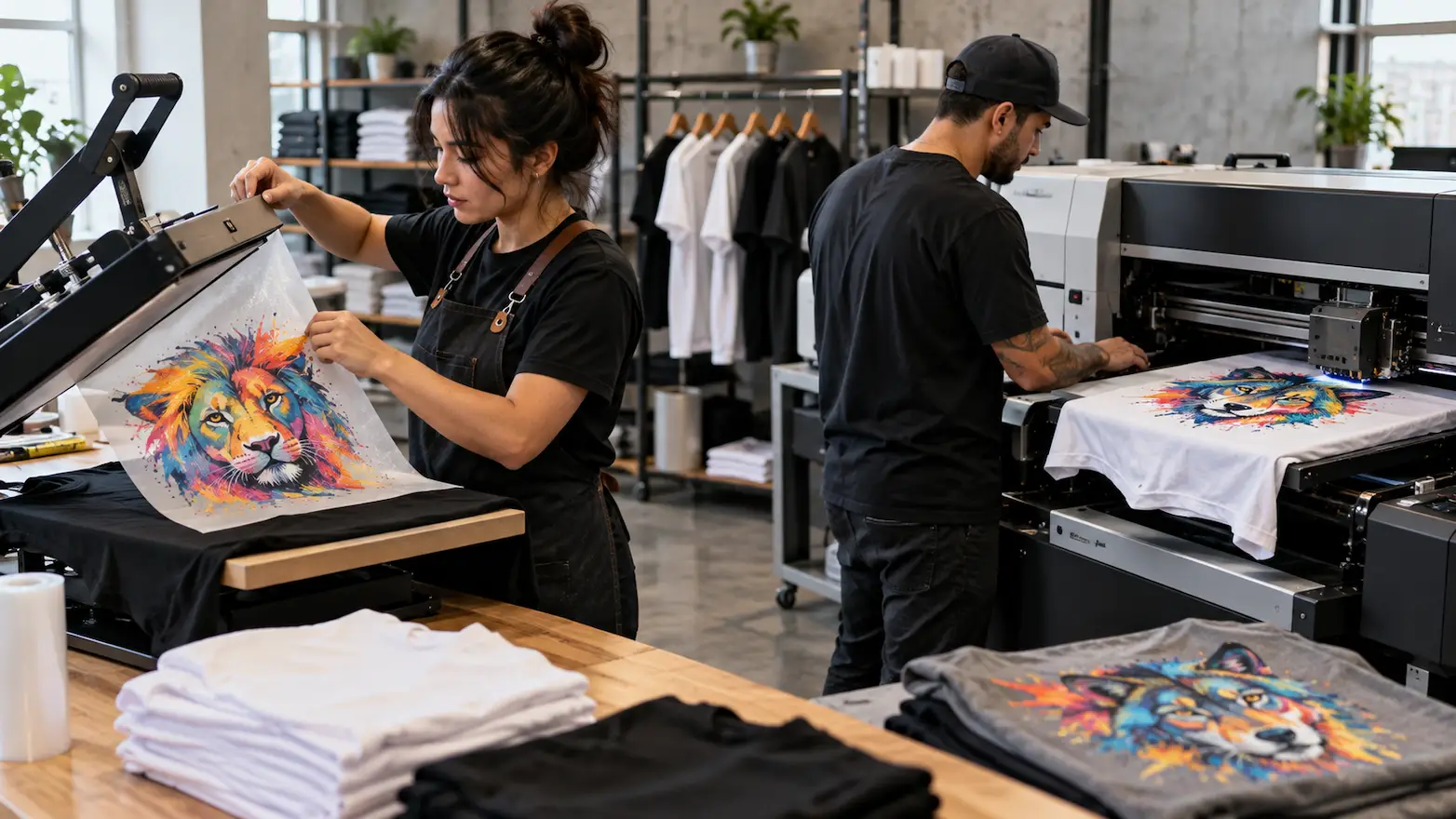
Screen printing applies ink to the garment surface through a mesh screen with a stencil burned into it. Each color in the design requires a screen. The ink is pushed through the areas of the stencil onto the fabric and the garment cures under heat to bond the ink to the fibers. Multiple colors are printed sequentially with each screen adding its layer to the design.
Those two production mechanisms produce results, different limitations and different economics. Understanding what each process can and cannot do is what makes the embroidery vs. Screen printing comparison rather than just a list of pros and cons.
Thumbnail-for-Embroidery vs. Screen Printing: Smart Strategies for Business Branding-By-Sew NC2.webp
What Embroidery Does Well
Embroidery shows quality in a way that no print method can copy. The three-dimensional look of thread on fabric feels like it was meant to be there and gives a high-end feel in person. That is why it has been the choice for company polo shirts, headwear and professional staff clothes for many years. A logo that is stitched onto a polo shirt or placed on the side of a good jacket has a visual importance that a printed version of the same logo on the same clothing does not have.
Durability is another benefit. Thread does not break, lose color or come off. An embroidered logo that is designed well and put on a midweight polo shirt or a cotton-blend sweatshirt will still be visible after a hundred times in the washer. For uniforms and work clothes that are used every day and washed often, durability is the reason why embroidery is picked instead of printing in professional clothing programs.
Embroidery also works on types of fabrics that printing has trouble with: caps with stiff front parts, polo knit fabric, canvas bags, fleece, denim and dress shirts made from woven material all take embroidery well when the design is made right and the fabric is supported properly.
What Screen Printing Does
Screen printing makes big images in a way that embroidery cannot do in a good way or at a low price. A strong picture across the front of a T-shirt, a big back image on an event hoodie or a colorful picture that covers a lot of the clothing are all situations where screen printing gives a better result than embroidery and costs less, per item.
At the right quantity, screen printing’s per-unit economics are difficult to beat. Once the setup cost for each screen is amortized across the run, the cost per printed garment drops significantly as quantity increases. For high-volume runs with consistent artwork across a large number of pieces, screen printing is the decoration method that produces the most economical result.
Color range is another area where screen printing has an advantage for certain artwork types. If a design has spot colors, clean linework and does not need very fine detail screen printing is the most efficient choice. Color photographic artwork and complex gradients need a more advanced setup. Standard branded apparel logos that use two to six spot colors are natural screen printing applications.
Where Embroidery vs Screen Printing Diverges the most
The artwork is where the embroidery vs. screen printing decision becomes most consequential. A logo that works beautifully as an embroidered chest placement may not translate as well to a large front print and vice versa.
Embroidery has a ceiling on detail. Fine text that is below about 0.3 to 0.4 inches in height loses legibility when stitched. Thin hairlines collapse. Gradients and photographic elements cannot be reproduced in embroidery without simplification. A logo that has vector shapes, bold typography and a limited color count digitizes well and produces a sharp embroidered result. A logo that has linework, micro-text or tonal variation needs to be rethought for the embroidery format before it can be produced cleanly.
Screen printing does not have the detailed ceiling for most standard artwork. Sharp lines, text at readable sizes and detailed illustrations all reproduce well through screen printing. The limitation is color complexity. Each color requires a screen and a design that uses eight to ten spot colors carries a setup cost that makes small-run screen printing expensive per unit. Gradients and photographic color blending require a simulated process or a halftone approach that adds production complexity.
Garment type also creates differences in the embroidery vs. screen printing comparison. Embroidery, on a woven surface a polo shirt, a woven jacket or a canvas bag produces predictable clean results. Screen printing on those same surfaces is less standard and sometimes less practical depending on the garment construction. Screen printing on jersey knit t-shirts and fleece hoodies is the most common and most tested application for that method.
Quantity and Cost Structure
This is where a lot of buyers end up making a mistake and it usually happens because they don’t think about screen printing setup costs when looking at the price per item. Screen printing needs a screen for each color in the design. A logo with three colors uses three screens. Each screen has a setup fee that is charged once for each printing run no matter how many items are printed.
When the number of items is small those setup fees take up a part of the total cost and make the price per item much higher than it would be for embroidery for the same logo on the same clothing. When the number of items is large those fees are shared among items and the price per item for printing goes down to a level that embroidery can’t reach.
The point where screen printing usually starts to be cheaper than embroidery is between 48 and 72 items for a logo, with two to four colors. Below that threshold, embroidery is usually the more cost-effective choice for most standard left chest or sleeve placements. Above it, and particularly above 144 pieces, screen printing’s economics pull ahead for print-appropriate applications.
Embroidery cost is driven more by stitch count than by quantity. A complex logo with high stitch count costs more per piece than a simple one, and that relationship holds across small and large runs. For simple, well-designed logos at any quantity, embroidery’s per-unit cost is more predictable than screen printing because it does not have the setup cost variability that makes small-run screen printing expensive.
Thumbnail-for-Embroidery vs. Screen Printing: Smart Strategies for Business Branding-By-Sew NC3.webp
Placement and What Each Method Supports
Standard placement options interact with the embroidery vs. screen printing comparison in ways that affect which method is appropriate for each location on the garment.
The left chest is the default professional placement for both methods. Embroidery at the left chest is the corporate apparel standard for a reason: it produces a clean, consistent result on most garment types at a size range that accommodates most vector logos without significant simplification. Screen printing at the same location works well on jersey fabrics but is less commonly used for corporate staff programs because it does not carry the same quality signal as embroidery at that placement.
Full front and full back placements belong to screen printing’s strongest applications. A large graphic covering the front chest of a t-shirt or the back panel of a hoodie is a print application, not an embroidery one. The stitch count required to fill a 10-inch front design in embroidery is expensive, slow, and adds stiffness to the garment that most recipients find uncomfortable on a casual jersey.
Sleeve and cap placements work well for both methods, though embroidery is more common and more durable on structured headwear and woven jacket sleeves. Screen printing on hats is a less common application that requires specific equipment and produces different results than embroidery on the same surface.
At Sew NC, the embroidery vs. screen printing question is one we answer based on the specific job rather than a preference for either method. Our custom embroidery services cover polos, jackets, headwear, bags, and workwear for business programs across the region, and we work alongside screen printing and DTF to match the right method to each application. When the job belongs in screen printing, that is the answer. When it belongs in embroidery, that is the answer.
Making the Comparison Work for Your Order
The embroidery vs. screen printing decision simplifies once the four key variables are clear. What does the artwork look like? Clean, simplified logos belong in embroidery. Large-format graphics and bold multi-color designs belong in screen printing. What garment is being decorated? Woven fabrics and structured headwear favor embroidery. Jersey knit and fleece favor screen printing for large designs. How many pieces are in the run? Small runs favor embroidery. Large runs favor screen printing once setup costs are amortized. How long does the decoration need to last? Daily-use staff uniforms and workwear favor embroidery’s durability. High-volume event merchandise where the garment has a shorter expected lifespan favors screen printing’s economics.
None of those variables exist in isolation. The right answer for a specific order is always the intersection of all four.
Reach out through the Sew NC contact page to talk through your production needs before the order is placed. The embroidery vs. screen printing conversation is shorter than most buyers expect, and the production result on the other end is significantly better when the method was chosen for the right reasons.