Embroidered sweatshirts show up on more planning spreadsheets than almost any other piece of branded apparel, and there’s a reason for that beyond the obvious. They survive a real winter of wear. They layer over whatever’s underneath. And three years from now, someone will still be wearing one, which is more than most companies can say about the printed giveaway from that one trade show.
Every team runs into the same stall eventually. Three embroidered sweatshirt mockups sit in a shared folder, nobody picks one, and the deadline creeps closer. Most of the time the holdup isn’t the design. Nobody’s walked through what survives daily wear, what the budget can absorb, and what the calendar allows.
That’s what this guide sorts out: where an embroidered sweatshirt genuinely earns its cost, what to nail down before the order goes in, and the handful of mistakes that turn a good idea into a box of size-mediums nobody claimed.
At Sew NC, we field this exact question most weeks from businesses, schools, and nonprofits across Winston-Salem and the Triad. The gap is almost never a lack of good options. It’s a missing plan.
Why Embroidered Sweatshirts Outlast the Alternatives
Screen printing wins the spotlight because it’s cheap for a single big run. Stitching plays a longer game. A printed graphic starts cracking around wash fifteen or twenty. Embroidery just sits there, unbothered, for years.
That’s really the whole pitch for choosing thread over ink on a sweatshirt. A logo stitched into a hoodie chest or worked into a quarter-zip collar carries weight a flat print never will, and it photographs better in front of a client too. Ask anyone who’s ordered both for the same team twice.
- Survives daily wear and wash after wash without complaint
- Reads as more professional in front of clients
- Holds its shape on thicker fabric where ink can crack or bunch
- Skips the fading, peeling, and cracking that vinyl and plastisol prints eventually show
Staff Apparel Where Embroidered Sweatshirts Pull Their Weight
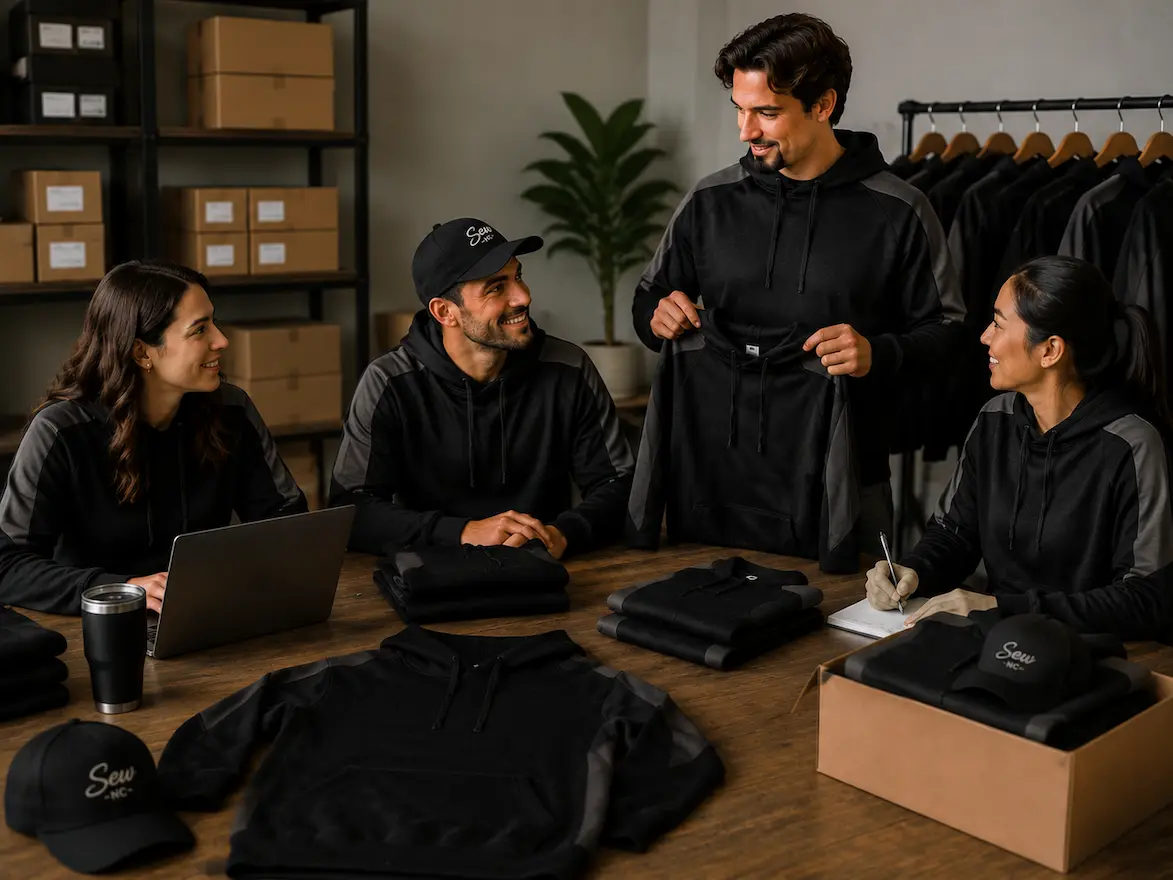
This is the request we hear most, usually from an operations manager or a small business owner trying to get the whole team looking like one company without building an entire uniform program from the ground up.
Split Teams Need a Split-the-Difference Piece
Half the crew is outside, half is behind a desk, and neither wants to wear what the other one’s wearing. A quarter-zip with embroidery tends to solve that better than a polo ever could. Warm at 7am, fine layered over a t-shirt by 2pm, and it won’t look strange walking into a client meeting either.
One landscaping company outside Winston-Salem handles this by putting left-chest embroidered crewnecks on crew leads and matching the color for the office staff. Same brand, same palette, completely different jobs.
- Small, left-chest logo for anything worn daily
- One neutral color that already matches the trucks or the signage out front
- A few extra sizes in stock; crews turn over faster than office rosters do
Gifts People Actually Keep
HR and marketing end up buying the exact same product for opposite reasons. One is building something inside the company. The other is putting the brand in front of people outside it. Embroidered pieces handle both jobs without much friction.
Hand someone an embroidered sweatshirt for an anniversary, an onboarding kit, or just because, and it reads as a gift, not a work requirement, especially in a color that has nothing to do with the daily uniform. Employees clock that difference immediately. There’s “here’s your shirt for work” and there’s “we picked this for you,” and people know exactly which one they’re holding.
Client gifts flip the same logic around. Nobody’s wearing a giant logo hoodie unless it looks like something they’d have bought themselves. Neutral color, small logo, heavier fabric. That combination gets worn.
- Employee gifts: a color that lives outside the standard uniform rotation
- Onboarding kits: one sweatshirt plus a couple of smaller items, not a box stuffed to the top
- Client gifts: subtle branding, no back print, nothing loud
- Anniversaries: a small stitched year or milestone detail adds weight without adding noise
Schools, Nonprofits, and the Teams Running on Tighter Budgets
Not every order like this comes from a corporate account. Booster clubs, school staff, and nonprofit teams ask just as often, and often with a bigger size range and a smaller number on the invoice.
Spirit Wear Doesn’t Skip the Wash Cycle
A booster club running a fundraiser typically needs sizing from youth small clear through adult 3XL, and embroidery survives the beating school apparel takes far better than a screen print does. It costs more per piece, which is exactly why most schools save embroidery for staff, coaches, and leadership instead of stitching the entire student roster.
Volunteers Wear the Same Piece for Years
A nonprofit running a recurring program tends to treat an embroidered sweatshirt as a low-turnover item, something a longtime volunteer or staff member wears for years rather than something reordered fresh every single event.
- Save embroidery for staff, coaches, and board members; print for the bigger volunteer or student batches
- Order more sizes than feel necessary at first glance
- Check that the logo still reads cleanly at a smaller embroidered scale before locking the design
Where Most Orders Go Sideways
None of this has anything to do with the sweatshirt. It’s colors, placement, and thread that trip people up.
Placement Isn’t a Style Choice, It’s a Practical One
Left chest earns its spot as the default because it works everywhere. Readable, doesn’t warp when someone moves, and it fits every silhouette from a crewneck to a full-zip hoodie. A full back design is possible, but it costs more and adds production time, so it’s worth asking whether the budget needs it before it lands on the order form.
Thread Doesn’t Match a Pantone Chart
Ink and thread are two different languages. If brand colors are specific, pull up a physical thread chart before signing off on anything, because a color that looks perfect on a monitor can land somewhere else entirely once it’s stitched into fabric.
- Check thread color against a physical chart, never a screen
- Skip small text in embroidered designs; fine detail turns to mush in stitching
- Get a digitized proof, not a flat mockup image, before production starts
Sew NC sews off a sample of every new logo before running the full order, which is exactly where a slightly-off thread color or an overly detailed logo gets caught, long before it becomes a finished batch of sweatshirts nobody’s happy with.
Fabric Weight Changes the Whole Feel
A heavier fleece holds its shape through years of washing and gives embroidery a cleaner surface to sit on, especially for a larger design on the back. Lighter blends breathe better in warmer climates or office settings, but dense stitching can pucker the fabric slightly if the backing isn’t right. Small detail. Ask about it before a bulk order covers both field and office roles at once.
Picking a Style That Fits the Actual Job
Not everything needs to be a hoodie, and guessing wrong on style is one of the more common mistakes we see land on our desk.
- Crewneck: clean and professional, best for office or client-facing settings
- Quarter-zip: works across temperature swings during the same shift
- Full-zip hoodie: casual, practical, built for events, warehouses, or outdoor crews
- Pullover hoodie: the most requested style for gifts, so check the dress code before it becomes daily wear
Quantities and Timelines Worth Planning Around
An embroidered sweatshirt order takes longer than a screen-printed one because of digitizing, the step where a logo gets converted into a stitch file the embroidery machine can read. One-time setup, but it adds a few days to a first order.
- Give a first order two to three weeks to account for digitizing
- Reorders on an already-digitized logo typically ship in seven to ten business days
- Pull sizes from actual rosters, not guesses; sweatshirts run bulkier than tees and sizing questions come up constantly
- Request a sample first for anything bigger than a small team
Timing It Around the Calendar
A handful of dates drive most of these orders across the Triad, and timing matters more than the design itself.
Employee Appreciation Day and end-of-year gifting are the two biggest windows for anything HR-driven, mostly because both call for something that reads as a gift rather than a work requirement. Back-to-school season pushes school and booster orders in fast, often faster than teams expect once fall sports and fundraisers stack up on the calendar. Trade show season plays by different rules: a booth crew wants something a visitor will actually keep, and an embroidered sweatshirt gets more mileage after the show than a printed giveaway ever does.
- Employee Appreciation Day and holiday gifting: get orders in three to four weeks out
- Back-to-school and fall sports: lock quantities before the first week of August
- Trade show season: plan around the show date, not the ship date; both take longer than people expect
- Anniversaries: settle the design early if a specific milestone detail needs stitching in
Planning around these dates instead of scrambling at the last minute is usually the entire difference between a smooth order and a rushed one.
Mistakes That Turn Up Again and Again
Most problems with a bulk embroidered sweatshirt order trace back to one of a handful of decisions made way too early.
- Approving from a flat mockup instead of asking for a digitized preview
- Choosing a logo with more detail than a small embroidered size can hold
- Guessing sizes instead of collecting them from the actual team
- Ordering exact headcount with zero room for new hires or damaged pieces
- Skipping thread color confirmation against the real brand palette
Getting these right the first time has less to do with the vendor and more to do with the questions asked before the order gets placed. That gap is usually the difference between a batch of embroidered sweatshirts a team wears for two winters straight and one that ends up folded at the bottom of a closet by March.
A field crew, a round of appreciation gifts, a booster club fundraiser, whatever the reason for the order, these details end up mattering more than the artwork itself. Sew NC handles proofing, thread matching, and sizing on every order before production starts, so what shows up matches what got approved, not a close guess at it.
Explore embroidered sweatshirt options for your organization, and get a quote from our team before locking in sizes, budget, or a deadline.